[The MDCP circa January 1996, 7 weeks and several kilobytes beyond its initial form]
 |
The MiniDisc Pageaccesses to date. |
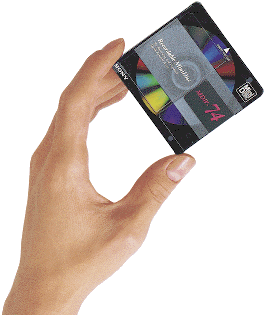 |
What are MiniDiscs?MiniDiscs were introduced by Sony in 1992 as a new digital medium for recording and distributing audio that is "near CD" in quality. There are two types: Premastered MDs, similar to CDs in operation and manufacture, and Recordable MDs, which can be recorded on repeatedly and employ magneto-optical technology. The disc itself is enclosed in a small (7cm x 7cm), convenient, cartridge. |
Is there a MiniDisc mailing-list?
Yes, send mail to [email protected] the message body should contain "subscribe md-l <your name>". This mailing list has sporadic discussions of MD related topics and is not particularly high traffic, on average. To unsubscribe, send a mail message to [email protected], the message body should contain "unsubscribe md-l".The MiniDisc FAQ was last updated 18 Jan 1996
How do MiniDiscs work?
A single MD holds the same amount of music as a CD (74min) but does so in one fifth as many bits by using an audio compression method Sony calls ATRAC (Adaptive TRansform Acoustic Coding). ATRAC is a form of perceptual coding, a data reduction technique that attempts to encode only the information audible to the human perceptual system. Perceptual coding, based upon the masking effect, is also the principle behind the Philips Digital Compact Cassette PASC compression, Dolby Labs AC-3 compression, and Bell Labs PAC (Perceptual Audio Coding) algorithm.The way data is actually stored on Recordable MDs is as follows (taken directly from Sony MZ-R3 manual): "The laser inside the recorder applies heat to the MD, demagnetizing the magnetic layer of the MD. The recorder then applies a magnetic field to the layer. This magnetic field corresponds exactly to the audio signals generated by the connected source. (The north and south polarities equate to digital "1" and "0".) The unmagnetized MD adopts the polarity of the magnetic field, resulting in a recorded MD". Sony describes the Magneto-Optical (MO) recording technology used for MDs in a technical paper on their HS MO system. For a few hard numbers, check Sony's MiniDisc Specifications.

A 1992 article from Audio magazine gives a good general introduction to the technology employed in MiniDisc.
Why should I get a MiniDisc recorder/player?
Sony intended the format as a replacement for the Compact Cassette. It provides a relatively low cost solution to making high quality recordings, and compared to Recordable CDs, it's smaller, cheaper and re-writable. Compared to all forms of tape, it provides random access, meaning that you can quickly select songs with the touch of a button. Its primary competition, the Philips Digital Compact Cassette (DCC), does not appear to have reached critical mass, and it is not clear it ever will.The only drawbacks to MD are the fact that you cannot make a perfect digital copy of one (there is generational loss in every decompress/compress cycle) and the relative high price of blank MDs (US$10-$15 for a 74 minute disc). However, in Japan prices are as low as $5 for a 60' blank and $6 for a 74' blank, and we can assume that eventually prices will reach these levels worldwide. An unabashed Minidisc fan argues the MD case (vs. DAT) in this mail message.
Where can I get a MiniDisc recorder?
Most large appliance/electronics stores carry the recorders and blank discs (e.g. Best Buy, Circuit City, Incredible Universe, Service Merchandise, and most electronics specialty shops). Some music chains like Tower Records and other large stores carry Prerecorded MDs, however the prices do not seem to be much different than most other CDs.Who makes blank MiniDiscs and where can I buy them cheaply?
There are multiple sources for the media: Sony, Kurare, TDK, Hitachi, Maxell, Idemitsu, and Zeus. A recent price survey of blank MiniDiscs gives MD US mail-order information.What is available in Prerecorded MDs?
Here is Sony's Prerecorded Minidisc Catalog.What MD products are available?
All major Japanese audio companies are now selling Minidisc products. They are Sony, Sharp, Aiwa, Denon, Onkyo, Sansui, Sanyo, JVC, Panasonic, Alpine, Clarion, Kenwood, Yamaha, and Pioneer.Here is an incomplete MiniDisc equipment feature table which includes the MD Data drives and the industrial units. Within the table are links to further information.
Links related to MDs:
- Sony, innovators of the MiniDisc.
- Sony's US Minidisc page.
- The Pro Audio FAQ is a good source of information about digital recording formats, equipment, and theory.
- MD technology borrows heavily from CDs. This paper, A Fundamental Introduction to the Compact Disc Player, provides a good introduction to digital recording theory and practice. Philips also has some excellent technical information about Audio CDs and Optical Disc Technology.
- The MPEG Audio Layer 3 FAQ, the Usenet Compression FAQ's Introduction to MPEG, the MPEG Information Page and these Audio Compression References give further information about MPEG Audio compression, one of the versions of which is actually the PASC system used by Philips.
- The DAT Home Page and the DAT-Heads FAQ contain information pertinent to digital and live recording, some of which applies to MiniDisc. In the FAQ there is a discussion of the digital SCMS (serial copy management system) and its circumvention.
- The Music Connection sells CDs as well as Mini Discs.
- Core Sound sells binaural microphones, ideal for MiniDisc recording.
- A place called POS makes CD copies of MDs for $25.
- The Home Recording Rights Coalition works to preserve your rights to purchase and use recording gear.
- Frank Beacham made a formal statement before congress in 1992 lobbying against the Audio Home Recording Act.
- A British MiniDisc page contains a few nice pictures, including a diagram of how the "shock-resistant" memory system works.
- A paper discussing the additive effects of audio compression algorithms explores concerns that broadcasters have.
- This cross reference table of commercial audio formats is quite useful.
Non-English MD Coverage
- Sony's complete MiniDisc site in Japan (be prepared to read Japanese).
- The Sony Netherlands MiniDisc page
- A Swiss (German) Article on the technical details of MiniDisc.
- Sony Deutschland's MiniDisc related press release archive.
- This Spanish MiniDisc page is written in English(?).
The Future
Aside from Sharp Corporation's casual mention of a 700MB MD Data drive they will have ready by 1997 (that's a 5X capacity increase) and the interesting possibilities that may present for higher quality MD audio, there is something of interest from NEC. It seems that just when we thought MiniDiscs were the leading edge of portable audio gear, NEC is showing a prototype of something it calls Silicon Audio which uses a solid state chip to store 24 minutes of MPEG Layer II compressed audio. It's still a few years off though.Feedback
Please address comments, updates, corrections, etc. to the page maintainers: Sumit Shah [email protected] and Eric Woudenberg [email protected]This page maintained simultaneously on the other side of the Pacific.
- First created on November 24, 1995
- Last updated on January 18, 1996